
by Samantha McClain
In late August, I went to visit my grandparents with my dad to attend a meeting about a funeral. This funeral was for John P. Cooper, a member of my family who fought and died in World War II.
A military member came to my grandparent’s house and presented my family with a PowerPoint presentation called “Past Conflicts Reparations Branch Identification Briefing.” During the briefing, my family and I discussed the Defense POW/MIA Accounting Agency (DPAA) and what might’ve happened to Pvt. Cooper.
My grandparents made a personal book with all the DNA analysis documents, John Cooper’s historical records, forensic odontology, and anthropology reports. In the DNA reports, two members of my family gave DNA samples: Micheal N. Chestnut, Pvt. Cooper’s maternal nephew and Randall C. Cooper, Pvt. Cooper’s paternal nephew. A third person donated their DNA; however, since the first two people confirmed the body of John Cooper, there was no need for a third confirmation.
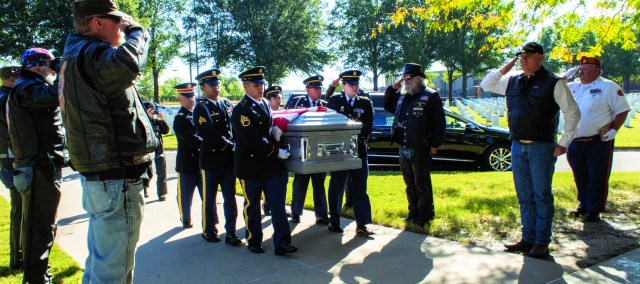
After 77 years of being an unidentified soldier who went missing during World War II, Pvt. John Pickney Cooper was accounted for on 21 June and laid to rest for the final time on 21 Oct.
Pvt. Cooper was born in Athens, TX, on 30 July 1907. In 1942, he tried to join the military at 37 years of age but was denied for being “too old.” According to the funeral pamphlet, he was turned down several times until he was finally accepted and joined the Army in 1944.
In March 1945, John P. Cooper was assigned to Company B, 778th Tank Battalion, operating in Germany as an M4 Sherman Tank crew member. In March 1945, his unit was engaged in the Battle of Lampaden Ridge. According to the briefing, his tank was hit by a German shoulder-fired rocket that struck the driver’s compartment. Then a 105 mm high explosive shell struck the left side of the tank.
According to dpaa.mil and the briefing, someone saw Pvt. Cooper and Cpl. William Mates, the tank driver, jumped off the tank and tried to evade the Germans, but they did not know what happened to them after that.
On 8 March 1946, the War Department presumed him dead. Several investigations were conducted in Pellingen, Germany, between 1946 and 1950. At the war’s end, the American Graves Registration Command was tasked with investigating and recovering missing American soldiers in Europe, according to dpaa.mil.
In August 1947, the American Graves Registration team recovered an unidentified soldier’s remains. Investigators could not positively identify the remains due to a lack of evidence. According to the obituary pamphlet, in Oct. 1951 he was officially declared non-recoverable.
In 2018, a DPAA historical team reviewed documentation related to the unknown soldier, according to their briefing. In June 2022, the remains were identified. After a multidisciplinary analysis, the Department of Defense and American Battle Monuments Commission transferred the remains to the DPAA laboratory, according to the briefing.
On 22 Oct. 2022, he was given a purple heart and a challenge coin. Pvt. Cooper’s name was marked with a rosette, indicating that he has been accounted for at the Walls of the Missing in Lorraine American Cemetery at St. Avold, France.
 Eagle View Newspaper