Experts encourage different approaches to changing the numbers
By Vivian Mejia
Eagle View Reporter
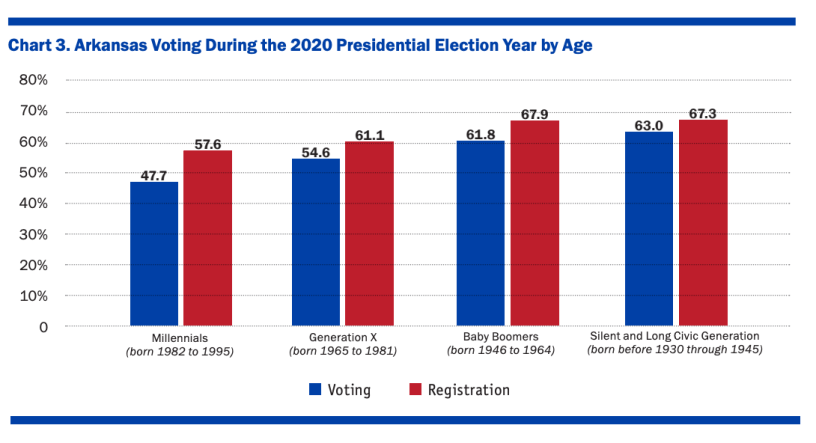
Arkansas has the lowest voter registration and turnout in national elections of any U.S. state, and voter turnout has declined in the past two generations, according to the Arkansas Civic Health Index and a report from the National Conference on Citizenship. Some people in Arkansas are hoping to change the numbers in this presidential election year.
The Arkansas Civic Health Index report was issued in late 2023. The report was produced in a cooperative effort of the National Conference on Citizenship, Engage Arkansas, the Winthrop Rockefeller Institute, Central Arkansas Library System, University of Arkansas Clinton School of Public Service, and the Arkansas Peace & Justice Memorial Movement.
According to the index’s figures regarding voter turnout, 44.7% of Arkansans reported voting in the last presidential election in 2020, compared to a national average of 55.3%. A presidential election year in Arkansas always kicks off with primary elections. This year’s March 5 primaries are part of Super Tuesday.
Primary elections are races in which voters can choose a political party’s candidates. Arkansas holds what are known as “open primaries,” where any registered voter may vote for one of a party’s nominees based on the party they select on Election Day. However, they are limited to voting for that party’s nominees in each race. There is also another voting option, which is a nonpartisan ballot. This ballot only contains nonpartisan judicial elections, annual and special school elections.
In a December 2023 interview with Roby Brock of Talk Business & Politics, Jay Barth, director of the Clinton Presidential Center, said that part of the reason for the low voter turnout is how civics education is taught. “Sadly, I think we’re not doing enough in terms of civic education to really prepare folks,” he said in the Brock interview. “In Arkansas, civics is often offered in ninth grade. That’s a long time before folks become eligible to become voters. We need to close that gap.”
“Voter turnout may be lower this year, as the Democratic race is uncontested and the Republican race may be decided by then, unlike 2016, when both parties had competitive races.”
Andrew Dowdle, political science professor, University of Arkansas
Barriers to voting identified by residents include long lines at polling places, lack of transportation, and disqualification due to prior criminal convictions.
With those listed challenges in mind, Washington County officials are working to make voting more accessible. All polling places must comply with the Americans with Disabilities Act.. The county has 42 polling places open this year so voters will not have to go to consolidated polling places to wait in longer lines and voters will not have to wait as long.
Election officials encourage everyone to think about all elections, said Jennifer Price, election coordinator for Washington County. Whether they are presidential, special or runoff elections, elections are important, she noted.
In addition, Washington County offers a program to get more young people to be engaged civically. “We have a high school program that trains students to become poll workers,” she said. “The goal is to make them life-long voters.”
In increasing youth participation, smart approaches encourage citizen participation in politics and provide tools and resources for citizens of all ages to cast an informed vote. Educating young voters about politics can build a global culture, generate family conversations about citizenship and increase voter participation, experts note.
This primary season is likely to still show room for improvement. “Based on previous years, we are predicting a voter turnout of 30% to 40%,” Price said. “The numbers are slightly higher for a Presidential Primary.”
Andrew Dowdle, a professor of political science at the University of Arkansas, explained some of the reasons it’s important to vote. “Because the turnout rate is lower, individual voters have more weight in the process, which may be a reason to vote,” he said. While voter turnout is higher in presidential election years, turnout in primaries is usually half of what it is in a general election. “Voter turnout may be lower this year, as the Democratic race is uncontested and the Republican race may be decided by then, unlike 2016, when both parties had competitive races,” Dowdle said.
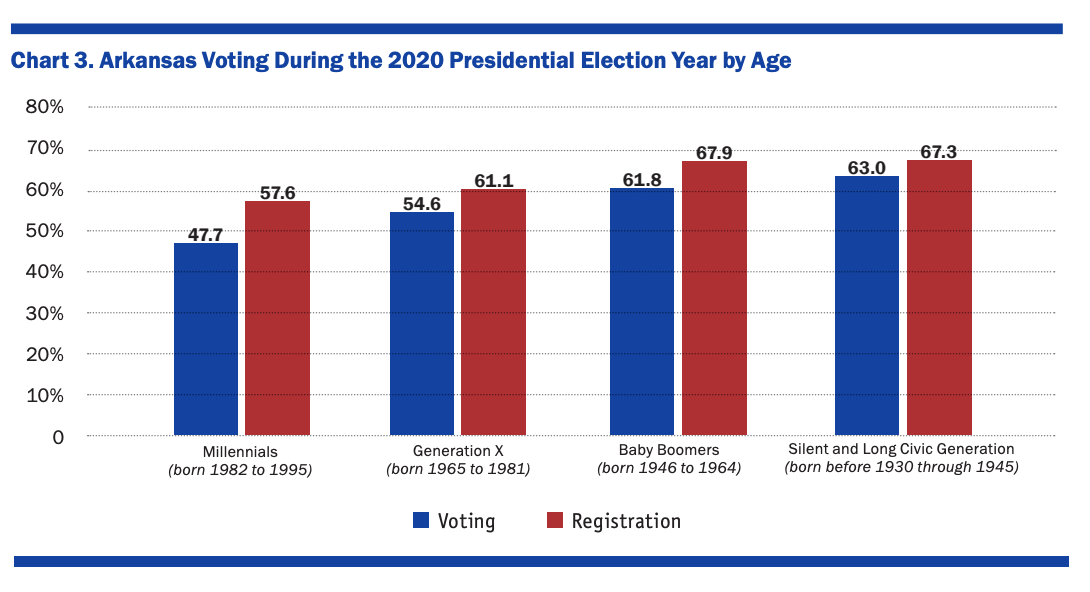
Image from 2023 Arkansas Civic Health Index
 Eagle View Blog & Community Media