
By Vivian Hernandez Mejia
Eagle View Reporter
Benton County and Arkansas voter turnout appeared to be less than 35 percent in preliminary returns for the March 5 primaries, local elections and non-partisan judicial races.
Benton County’s voting participation was under 20% with preliminary, unofficial numbers showing 33,912 ballots cast or 18.72% voter participation.
County voters cast 28,573 Republican ballots, 4,606 Democratic ballots and 733 nonpartisan judicial ballots. The early votes tallied 15,720 ballots cast with 302 absentees and 15,418 ballots cast at early voting locations. The registered voters counted to be 181,192 with an 8.68% early voter turnout in Benton County.
Washington County early voting tallied to have 8,897 ballots casted with 138,184 registered voters, coming out to be an 6.44% early voting turnout in the county.
The lower participation rate is keeping with the trend that experts predicted in interviews prior to election day.
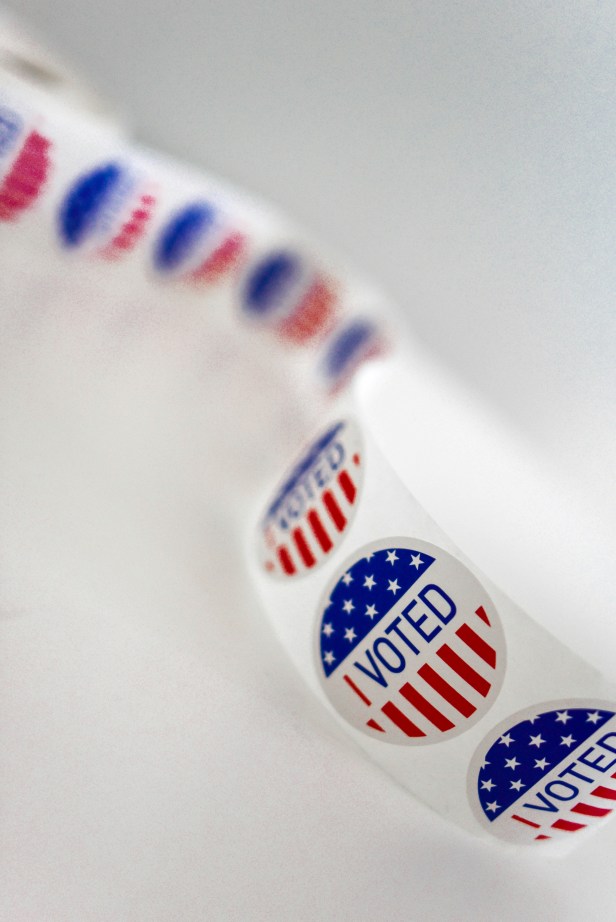
“Based on previous years, we are predicting a voter turnout of 30% to 40%,” Jennifer Price, Washington County election coordinator, said last month. “The numbers are slightly higher for a presidential primary.”
Andrew Dowdle, professor of political science at the University of Arkansas, explained some of the reasons it’s important to vote. “Because the turnout rate is lower, individual voters have more weight in the process, which may be a reason to vote,” he said. While voter turnout is higher in presidential election years, turnout in primaries is usually half of what it is in a general election.
“Voter turnout may be lower this year, as the Democratic race is uncontested and the Republican race may be decided by then, unlike 2016, when both parties had competitive races,” Dowdle said.
Carol Stuckey, one of the Benton County poll workers at NWACC, said she hoped that more young voters choose to cast ballots and begin to make voting a lifetime habit. “I just want to be part of the election, help out,” Stuckey said.
At approximately 4 p.m. March 5, Stuckey said 169 people had voted. Later, 236 people had cast ballots by 6:15 p.m.
Voter turnout may be lower this year, as the Democratic race is uncontested and the Republican race may be decided by then, unlike 2016, when both parties had competitive races
— Andrew Dowdle
Arkansas has historically low registration and turnout. In fact, the state had the lowest voter registration and turnout in national elections of any U.S. state, and voter turnout has declined in the past two generations, according to the Arkansas Civic Health Index and a report from the National Conference on Citizenship.
The Arkansas Civic Health Index report was issued in late 2023. The report was produced in a cooperative effort of the National Conference on Citizenship, Engage Arkansas, the Winthrop Rockefeller Institute, Central Arkansas Library System, University of Arkansas Clinton School of Public Service and the Arkansas Peace & Justice Memorial Movement.
Primary elections are races in which voters can choose a political party’s candidates based on the ballot they request. Arkansas holds what are known as “open primaries,” where any registered voter may vote for one of a party’s nominees based on the party they select on Election Day. However, they are limited to voting for that party’s nominees in each race. There is also another voting option, which is a nonpartisan ballot. This ballot only contains nonpartisan judicial elections, annual and special school elections.
According to the Arkansas Civic Health Index’s figures regarding voter turnout, 44.7% of Arkansans reported voting in the last presidential election in 2020, compared to a national average of 55.3%. A presidential election year in Arkansas always kicks off with primary elections.
Barriers to voting identified by residents include long lines at polling places, lack of transportation and disqualification due to prior criminal convictions.
NWACC has hosted a polling location for several elections, and Stuckey, who was working at the location on Tuesday, said that college students were among the voters.
Matt Evans, professor of political science at NWACC, said that college students typically have the lowest voter turnout and retired individuals have the highest.
“This dynamic means that those closer to death exercise an outsized influence over those further away from it. We have a gerontocracy and that works counter to democracy, and that delegitimizes the outcome of elections, as well as law, policy, and taxation by the government,” Evans said.
Stephanie Roat, Delaney Reaves and Samantha McClain contributed to this report.
 Eagle View Newspaper