
By Delaney Reaves, Editor-In-Chief
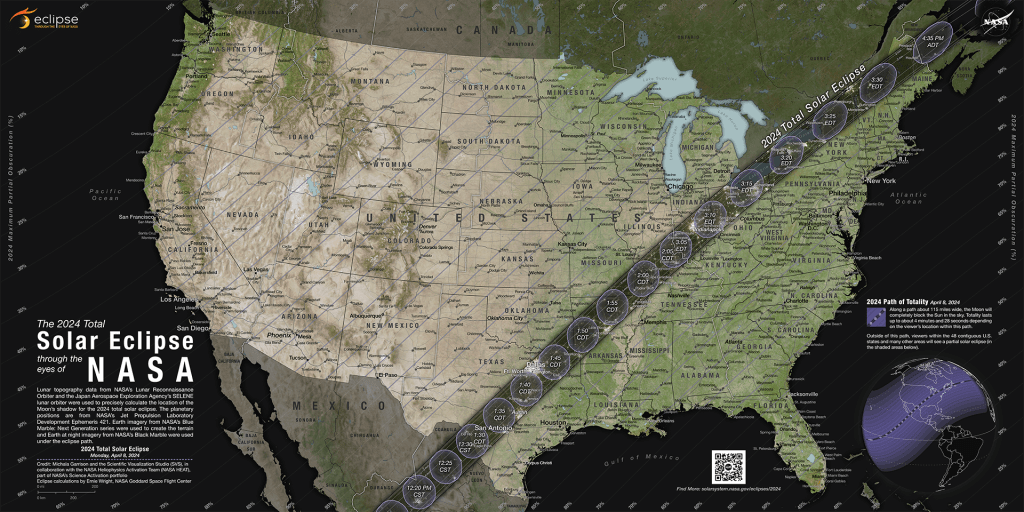
On April 8, a total solar eclipse will pass over the United States, North America, Mexico and Canada and begin over the South Pacific Ocean, according to NASA. The Great North American Eclipse will visit Arkansas starting at 1:45 p.m.
NWACC’s Bentonville campus is expected to experience a 98.6 percent eclipse of the Sun instead of totality. On that day, a number of events are planned for the college and the larger community.
A few cities in Arkansas will be in the path of totality: Little Rock, Hot Springs, Texarkana, Conway and Jonesboro. The path of totality is a narrow, long path displayed on a map showing where the eclipse can be seen at totality. Two-thirds of Arkansas will lie in the path of totality.
The moon will move between the Earth and the Sun, casting a shadow on the Earth, resulting in a Solar Eclipse. Light is able to bend around things of massive gravity like the moon, which will bring a dusk, not a nighttime darkness. According to NASA, the longest duration of totality is 4 minutes and 28 seconds, near Torreón, Mexico. Most places in the centerline (path of totality) will see a duration between 3.5 and 4 minutes.
Some school districts will close on April 8, including the Fayetteville school district.
“Arkansas officials said Monday that they expect between 300,000 and a million people to visit the state for next month’s total solar eclipse that will cover much of the state from southwest to northeast Arkansas”, according to an article from the Arkansas Advocate.
According to a Democrat-Gazette article, hotel rates are expected to rise and capacity levels of hotels are filling fast.
The best place to see the solar eclipse is where totality can be seen, which is when the Sun is completely covered by the Moon. April’s solar eclipse can be seen anywhere without clouds or weather that could cover visibility in the sky.
The Corona, the outermost part of the Sun’s atmosphere, is hidden by the bright light of the Sun’s surface making it difficult to see, due to the Moon coming into alignment, it will be visible.
Though the eclipse will not negatively affect life on Earth, but due to darkness some nocturnal creatures will be confused and start to awaken.
Katherine Auld, Science Department co-chair and astronomy instructor, said that NWACC plans to host a festival and viewing party on the Bentonville campus. Activities will be from noon to 4 p.m.
The festival on Bogle Plaza outside of the student center on the day of the eclipse will feature groups from campus talking about eclipses. Glasses for viewing will be given away, tables will be set up, and solar eclipse-related activities are planned.
Auld said the eye’s retina, vital for the eye’s vision, does not have pain receptors. So, when looking at an eclipse of the Sun, the eye will not feel different, but direct viewing will damage the retina. It is also suggested that camera lenses use a filter made of the same plastic as the glasses for photos and videos. Binoculars, telescopes or any other viewing device directly pointed at the eclipse Sun need a filter.
Springdale Explore Scientific in NWA sells filters for use on cameras, telescopes and binoculars.
“Even though the sun here will be tiny and it will look dark, wear your glasses,” Auld said.
Total solar eclipses don’t happen very often because the Earth is tilted compared to the sun so the moon is not directly in between the sun and Earth often. If the moon orbited in the same plane (or line) as the sun, then every month an eclipse would happen. But with the moon’s tilted orbit path the shadow falls under or below more often than it lines up with the Earth and Sun. Only very periodically does the moon align with the sun.
The sun is 400 times larger than the moon but also 400 times farther away. The Earth is the only place in the solar system where total solar eclipses happen because the moon is big enough to cover the sun.
Orbital mechanics is the reason that solar eclipses occur. “It is actually sort of a cool accident of the universe that the sun and the earth and the moon are just exactly the right size and distance,” Auld said.
“This localized blocking of solar energy is useful for studying the Sun’s effects on our atmosphere, especially the upper atmosphere, where the Sun’s energy creates a layer of charged particles called the ionosphere,” according to NASA’s website.
Understanding the ionosphere, the Earth’s upper atmosphere, is valuable because it is home to many low-Earth orbit satellites, communications signals like radio waves, and signals that make GPS operate.
According to NASA, the next solar eclipse will be on Aug. 23, 2044, and the longest total solar eclipse will occur on July 16, 2186, lasting 7 minutes and 29 seconds.
Sugar Creek Astronomical Society, an amateur astronomy club for Bella Vista, hosts events at Hobbs State Park six times a year for interested skywatchers.
The Perseid meteor shower will peak the night of Aug. 12 and before dawn on Aug. 13, with around 50-100 meteors per hour. Due to its speed, the best way to view this meteor shower is away from any lights and without a telescope.
Solar Eclipse Viewing Party
Day: April 8
Time: Noon to 4 p.m.
Information: Email Mallory Pummill at mpummill@nwacc.edu
 Eagle View Blog & Community Media