Vivian Mejia
Reporter
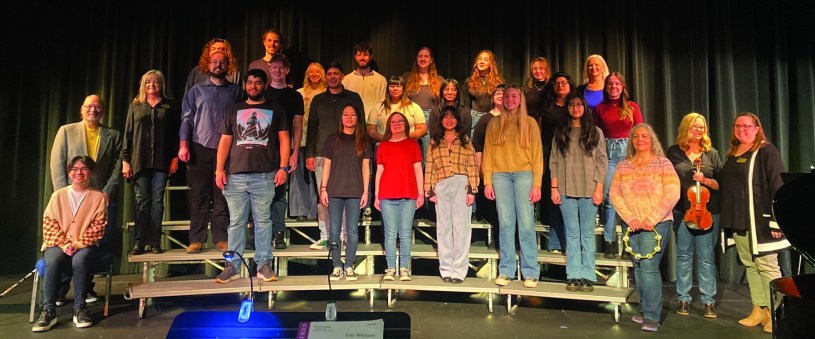
NWACC Chambers Singers performed “Five Hebrew Love Songs” on Thursday, March 7 for Spring Arts and Culture Festival. “Five Hebrew Love Songs” by composer Eric Whitacre from texts by Hila Plitmann, a work for soprano, alto, tenor and bass with piano and violin accompaniment.
In the spring of 1996, violinist Friedemann Eichhorn invited Eric Whitacre and his then girlfriend Hila Plitmann (soprano) to give a concert with him in his hometown Speyer, Germany. Friedemann asked Eric Whitacre to write a series of songs for piano, violin and soprano. Whitacre asked Hila Plitmann who was born and raised in Jerusalem to write him a few “postcards” in her native language, and a few days later she gave him these delicate Hebrew poems.
The performance directed by Freeda Goodman and accompanied by pianist Traci Hall also featured a narrator, a violinist and a tambourine player. The songs were in Hebrew but narrated and translated by NWACC Professor Douglas Krueger.
This event let the audience hear the Hebrew language in a musical way. It lasted approximately 30 minutes, the 20 members of the NWACC Chamber Singers Choir under the direction of Professor Freeda Goodman, performed these songs. With this performance the choir seeked to capture special and memorable moments as they performed these romantic songs.
These love songs are Temuná (a picture), Kalá Kallá (meaning “light bride”), Laróv (mostly), Éyze Shéleg! (what snow!) and Rakút (tenderness). Kalá Kallá was a play on words that Friedemann came up with while Hilda was teaching him Hebrew. The bells at the beginning of Éyze Shéleg! are exact tones from what they woke up to every morning in Germany that rang in a nearby cathedral. Each of the songs captures a moment that Hila and Friedemann shared together.
Professor Goodman has been teaching at NWACC since 2012 as a voice teacher, music appreciation teacher and now director of NWACC Chamber Singers. She told about her experience and the preparation put in for this performance.
“It was very difficult to prepare since no one speaks Hebrew, we had to learn the syllables, word by word, very slowly, but this choir is amazing.”
Freeda Goodman
She explained that they based it on a YouTube video of the woman who wrote these Hebrew poems and she speaks each poem the way it should be pronounced.
The SACF coordinators encouraged Professor Goodman to help with this project because it’s a way to show a culture in a musical way that many don’t know about.
Goodman said that It was a great experience doing these songs, with the type of music that they had never done before, but it was a great experience and the choir had a wonderful audience.
 Eagle View Newspaper