A glimpse inside NWACC’s Regional Disaster Drill
Debbie Upson/Reporter
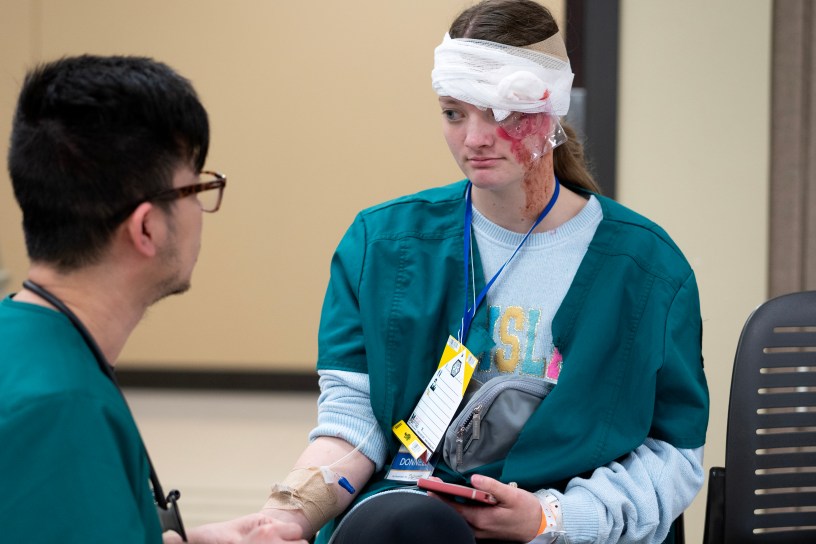
“Help, I’m having a heart attack!” shrieked “Lily” as she bolted out of the “emergency room” door with several green scrubbed figures in tow. It wasn’t a typical Friday morning. It was NorthWest Arkansas Community College’s first Regional Disaster Drill.
The Center for Health Professions on NWACC’s Bentonville campus didn’t look any different from the outside on Friday morning, March 8. But its lobby and hallways, usually filled with students cramming for their next Pharmacology or Med-Surg test, now held “pregnant” patients heading for the Neonatal Intensive Care Unit, “disaster victims” with oozing head wounds and “missing” limbs, and “EMTs” hiding around the corner, waiting for just the right minute to wheel their next “patient” to triage.
The disaster drill was a combined effort between the nursing departments at John Brown University, Crowder College, Harding University, the University of Arkansas for Medical Sciences, and NorthWest Arkansas Community College.
Nursing students and staff from all the participating schools worked together on one combined disaster simulation held simultaneously at John Brown University and on NWACC’s Bentonville and Washington County campuses. Faith Paine, the NWACC nursing instructorwho coordinated the regional disaster drill, said that she, John Ezell, a nursing instructor at Crowder College, and Lauren Haggard-Duff, a nursing instructor at UAMS, “were all in Joplin the night of the big tornado. All of us had a role in that event and that is why this is very important to all of us.” Paine said nurses don’t always know what is going to happen, so this is why they prepare students, and specifically prepare nurses for these big, life-changing events.
In the planning stages of the drill, Paine said they looked at what type of scenario would be the most impactful in this area. Planners decided this year’s simulation would involve a hypothetical explosion or a terroristicweapon being detonated at the Walmart home office. The simulation would then involve treating the “casualties” that came streaming into the three different “hospitals” as well as treating their current census of previously admitted patients.
Bystanders, who pressed up against one of the hallways in the Center for Health Professions in Bentonville that morning, might have caught a glimpse of one of the “casualties” screaming in Spanish as his gurney careened past them with a seeping bandaged elbow protruding rigidly at a right angle from his chest and his other arm wildly flailing a severed plastic arm.
Sliding down the wall a little farther, curious onlookers might have caught a glimpse of Jason Cobb or at least heard him. Cobb, an NWACC nursing student playing the part of a detoxing alcoholic whose Diazepam orders did not follow him to the Med-Surg floor, was “vomiting” in the hallway. In the midst of the crisis, it took three nurses to get him out of the hallway and settled back into bed. Cobb played the part of the kind of patient who takes 10 minutes when health professionals only have two. The kind of patient who might catch his IV tubing on the bed’s side rail, yanking the catheter from his arm just when his 9 a.m. meds are past due, and room 205’s surgeon is looking for the nurse.
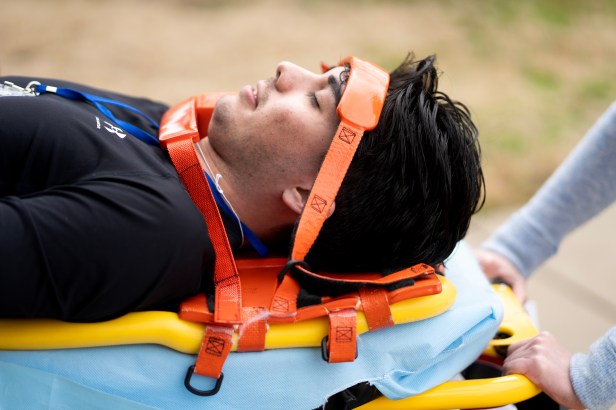
Jon Hart, an NWACC nursing instructor and experienced critical care nurse, said some of the nursing students involved described their experience as chaotic. Hart said his response as a nursing instructor was, “Good, that is what we are trying to teach you to work with.” He said the drill is designed to teach students “how to prioritize care in a crisis, how to make decisions quickly and how to triage care based on true need.”
[A] disaster isn’t over when the disaster is over. There are months and years sometimes of recovery.”
Faith Paine
Nursing students and staff members played the part of the nurses, hospital staff, patients, EMTs, the press, and concerned family members. The event was choreographed down to the exact minute each new patient would burst through the doors into the triage area. Each participant had a distinct part to play. Some played obvious roles such as a triage or ER nurse. But some roles involved behind-the-scenes activities like managing limited equipment supplies, communicating between area hospitals, and dealing with the “press” and their cardboard cameras.
Each “hospital” was filled with multiple departments. On the Bentonville campus, the main nursing lab was the emergency room, complete with an “ER doc” played by Hart. Across the hallway, the radiology department “staff” were doing hypothetical CT and MRI scans. And inthe adjoining waiting room, at least one irritated, vocal, and minorly injured “patient” could
be heard punctuating the air with his discontent. Around the corner from the main nursing lab, the CNA and PCA lab held the Med-Surg floor, and right inside the building’s main doors was the triage area. Here, an observer could find expectant eyes peeking above the tops of disposable masks as “nurses” clad in their semi-transparent yellow infection control gowns watched for their next patient to burst through the front doors. Tucked away on the third floor were the intensive care and neonatal intensive care units.
Each campus had a different mix of students. NWACC’s Bentonville campus had NWACC and Crowder nursing students. John Brown University had primarily UAMS, JBU, and Harding University students, and NWACC’s Washington County campus had NWACC and Crowder students. A total of 303 nursing students participated, 168 from NWACC. Paine said the drill was also “about teaching teamwork … having students from different schools come to our school was important because sometimes that happens in a disaster, and you don’t always know the capabilities of the people you are working alongside.”
The drill, starting at 9 a.m., was over at 10:30 a.m. However, unlike in the real world, studentsknew this wasn’t a true disaster, and they knew when it would be over. However, at 10:30, when the seeping bandages were removed, missing limbs were “found,” and “Lily” became Alexa Carnahan again. Paine said there were counselors onsite on all three campuses to talk to the students about how to deal with the after-effects. She said even though this isn’t real, providers treat it like it is because someday it could be. She added a “disaster isn’t over when the disaster is over. There are months and years sometimes of recovery.”
This year, only nursing students and staff participated in the event. Next year, Paine said they would love to have some first responder partners come and help with the EMS side.
NWACC’s nursing department is planning for this to be an annual event with a different scenario each year. Paine said some graduating NWACC nursing students have already volunteered to come back to campus and participate in next year’s simulation. It is scheduled for March 5, 2025.
 Eagle View Newspaper