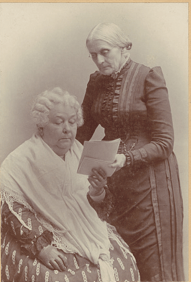
Elizabeth Cady Stanton (seated) and Susan B. Anthony (standing) Photo from the Library of Congress
By Jaden Burgett
Eagle View Staff
The preamble to the constitution begins with “We the People of the United States.” Such a phrase would suggest an attempt at inclusivity; yet, for women throughout history, this is simply not the case. The road to equality, at least on paper, began in 1787 with the adoption of the Constitution. This document shined a spotlight on exactly what rights a woman could expect not to be made available to her. Oppression continues to occur today, with blatant examples reaching as far as the White House, though the severity has decreased over the years thanks to many prominent female figures and the changes they helped to pass.
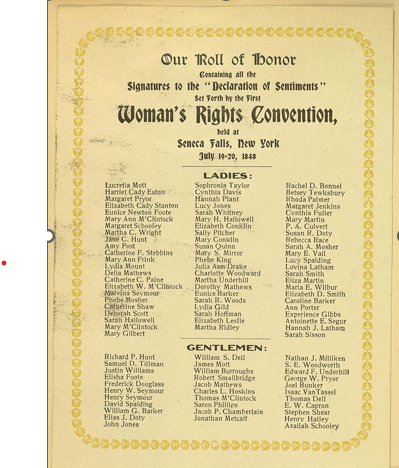
Without the right to vote or hold office women had no voice in what the future held. Elizabeth Cady Stanton, Lucretia Mott, Mary Ann M’Clintock, Martha Wright, and Jane Hunt pushed to give women a voice by organizing the first women’s rights convention held in Seneca Falls, New York in 1848. This convention produced the Declaration of Sentiments, which highlighted the injustices women faced while demanding initiatives such as the right to vote, the right to own property, and the right to receive an education. The women who organized this convention sparked the women’s suffrage movement in the United States creating a foundation for a hopefully much brighter future.
Elizabeth Cady Stanton not only helped to organize the first women’s rights convention, but she, alongside Susan B. Anthony, also helped found the National Woman Suffrage Association. Established in 1869, the NWSA had a primary aim of achieving women’s right to vote, while also organizing speeches, other conventions, and lobbying Congress. Eventually, the NWSA would merge with the American Woman Suffrage Association to form the National American Women Suffrage Association in 1890. The merging of these two associations was a significant step towards unifying the women’s suffrage movement in the United States.
Efforts of the NAWSA paid off with the ratification of the 19th amendment in 1920 allowing women the right to vote. The amendment had been first introduced in 1878 but did not pass the House and Senate until 1919. Tennessee became the 36th state to approve this amendment allowing ratification due to the necessary three-fourths state majority. The campaign for women’s suffrage was by no means over as the struggle to include African American women and other minorities continued.
Four years later the Equal Rights Amendment was introduced into Congress by Alice Paul, a suffragist and advocate for women’s rights. The ERA proposed that regardless of sex all American citizens deserved equal rights. By 1972 the ERA was passed by both houses of Congress and sent on to the states for ratification. The amendment required 38 states’ approval to be adopted, though the amendment fell short of this stipulation by three states. Even with an extension, the deadline for ratification proved to be too great, thus the ERA is still debated to this day. Congress continues its attempts at clarification of the Equal Rights Amendment in the hopes of one day incorporating this amendment into the Constitution.
The Equal Rights Amendment may not have passed but it had helped to set precedents for equality to persevere, as both the Equal Pay Act and the Civil Rights Act came into play. The Equal Pay Act was signed into law by President John F. Kennedy in 1963, requiring equal pay for equal work, coverage for all forms of compensation, and helping to narrow the gender wage gap. The Civil Rights Act became the next landmark piece of legislation in the United States, signed into law by President Lyndon B. Johnson in 1964. The Civil Rights Act outlawed discrimination based upon race, color, religion, sex, or national origin. The combination of these two acts helped to reduce discrimination for women while also working towards ending segregation, issues that continued to plague the United States.
The Equal Pay Act proved only a jumping-off point for the problem of wage equality in the United States. Lily Ledbetter, a production worker for a Goodyear Tire plant in Alabama, discovered she was being paid significantly less than men holding the same position, which led to her pursuit of a legal suit regarding equal compensation. Initially, Ledbetter succeeded in winning the suit though the verdict was overturned due to the statute of limitations. The verdict of her case led to the Lily Ledbetter Fair Pay Act being added to the legislation, thus helping to amend the 180-day statute of limitations for an equal pay lawsuit set by the Civil Rights Act of 1964. Based on statistics provided by the U.S. Department of Labor, women in 2024 still face a severe wage gap, making only 84% of what men make today, thus signifying work on wage equality is still much needed.
The battle for women’s rights has been ongoing and will continue until equality and justice persevere. The timeline for this struggle is and will be arduous for all parties involved though that is not an indication of compliance or defeat. A victory for equality for women will be hard-won, thus making each triumph more meaningful and prominent. The modern women of today continue fighting the battles of the women who came before them with a much larger voice capable of being heard around the world. The United States Constitution made promises that women today demand be made, regardless of sex, equality does mean everyone.
Sources:
Paula Casey: Scholar on Voting Rights (pfcasey@bellsouth.net)
Tina T. Williams: Department of Labor – Gender Discrimination
https://www.nps.gov/articles/declaration-of-sentiments-the-first-women-s-rights-convention.htm
https://www.britannica.com/topic/National-American-Woman-Suffrage-Association
https://www.archives.gov/milestone-documents/19th-amendment
https://www.history.com/this-day-in-history/equal-rights-amendment-passed-by-congress
https://www.eeoc.gov/statutes/equal-pay-act-1963
https://www.archives.gov/milestone-documents/civil-rights-act
https://www.eeoc.gov/laws/guidance/equal-pay-act-1963-and-lilly-ledbetter-fair-pay-act-2009
Jaden Burgett is a member of the NWACC Eagle View staff and was a student in the fall 2024 Media Writing class.
 Eagle View Newspaper